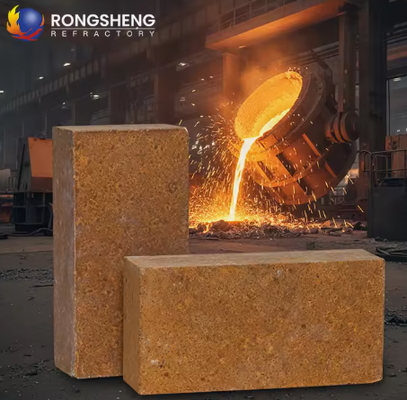
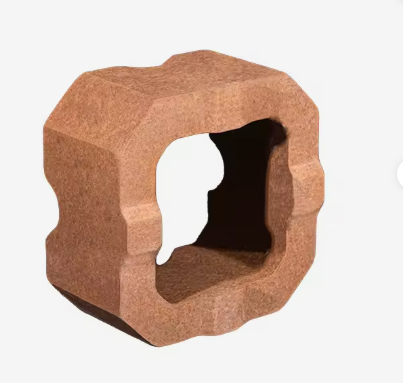
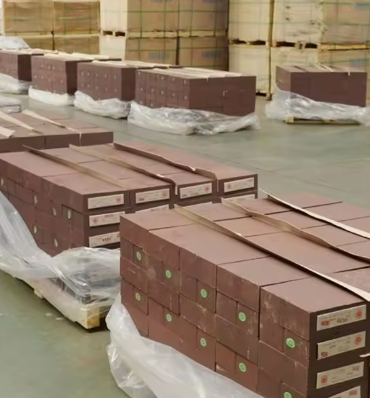
Refractory Magnesia Brick:
Magnesia refractory bricks are alkaline refractory materials primarily composed of magnesium oxide (MgO) and periclase as the primary crystalline phase. The MgO content is typically over 80%. Magnesia bricks are manufactured by crushing, batching, mixing, and high-pressure forming (usually by mechanical pressing) of sintered magnesia sand. Finally, they are fired in tunnel kilns or downdraft kilns at ultra-high temperatures exceeding 1500-1600°C. With a refractoriness typically exceeding 2000°C, magnesia bricks offer excellent resistance to high temperatures and alkaline environments, making them an indispensable and critical lining material in high-temperature industries such as steel and cement.
Characteristics of Refractory Magnesia Bricks:
1. High refractoriness: Magnesium oxide has a melting point of up to 2800°C, making the refractoriness of magnesia bricks typically over 2000°C.
2. Excellent alkaline corrosion resistance: Magnesium bricks are extremely resistant to alkaline slag and alkaline dust (such as CaO and FeO).
3. High refractoriness under load: Magnesia bricks exhibit excellent structural stability at high temperatures and are not prone to collapse.
4. High compressive strength: Magnesium bricks have high compressive strength at both room temperature and high temperature, and exhibit excellent mechanical properties.

Refractory Magnesia Brick Advantages:
1.Longevity and Durability: In alkaline environments, its excellent corrosion resistance significantly extends the service life of the kiln lining, reducing maintenance downtime and improving equipment availability.
2.High-Temperature Stability: Its extremely high refractoriness and refractoriness under load ensure safe and stable operation in extremely high-temperature environments, making it an ideal choice for critical parts of high-temperature kilns.
3.Purifying Molten Steel: In steelmaking furnaces, magnesia brick linings are less susceptible to reacting with alkaline impurities in the molten steel and can even absorb them, helping to improve the purity of the steel.
4.High Cost-Effectiveness: The long life of magnesia bricks in suitable environments results in lower overall operating costs and higher economic benefits.


 Your message must be between 20-3,000 characters!